LOUISE LAWLER « NO DRONES », SPRÜTH MAGERS, BERLIN
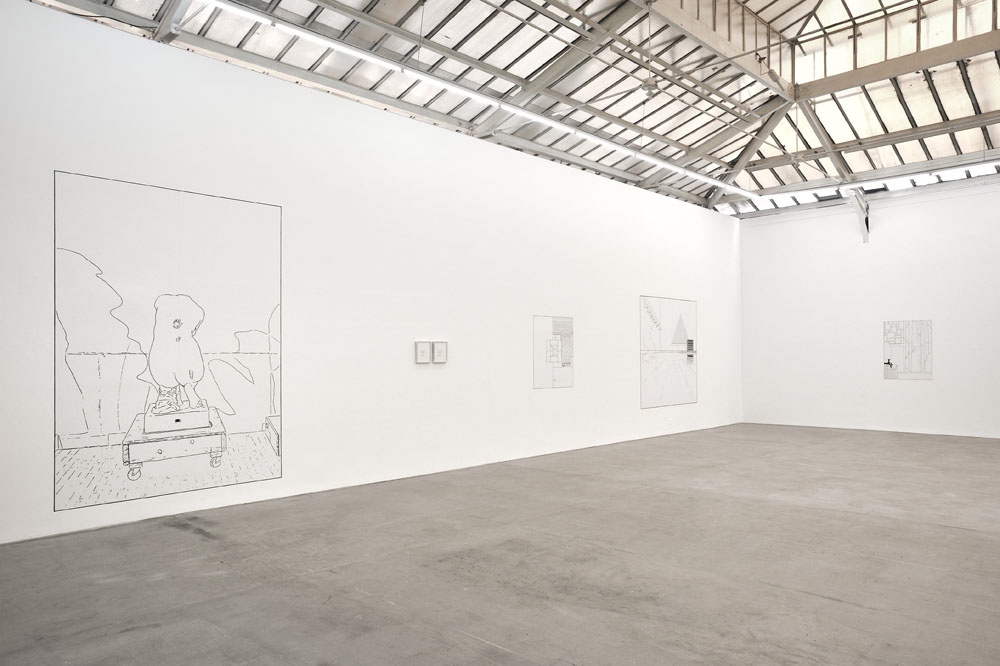
LOUISE LAWLER : NO DRONES / Sprüth Magers, Berlin / November 14th – January 17th 2015.
Depuis ces 30 dernières années, les photographies de Louise Lawler dépeignent des vues d’objets et des oeuvres d’art dans leurs environnements quotidiens, donnant au sujet depuis son poste d’observation toute son importance, encadrant les dispositifs et les modes de monstration qui affectent la réception d’une oeuvre d’art. Pour No Drone, Lawler expose un groupe de ‘tracings’, une série qu’elle a développée pour son exposition au Musée Ludwig à Cologne en 2013.
Les ‘tracings’ sont des dessins au trait, noirs et blancs, convertis en vecteur graphique et imprimés sur un vinyle adhérant directement au mur. Chaque édition existe comme un fichier numérique adaptable qui peut être imprimé à n’importe quelle taille. La série particulière de tracings exposés à cette occasion, par exemple, a été produite pour s’adapter aux grands murs de la galerie de Berlin. Un ‘tracing’ se matérialise seulement quand il est exposé et il peut être détruit ou refait dans une taille différente pour sa présentation suivante. Certaines des œuvres de cette exposition sont les éditions de 10, tandis que d’autres sont des éditions illimitées.
Over the last 30 years, Louise Lawler has been making photographs that depict views of objects and artworks in their everyday working environments, shifting the emphasis from the subject itself to vantage points, framing devices and the modes of distribution that affect the reception of an artwork. For No Drones, Lawler will exhibit a group of ‘tracings’, a series that she developed for her exhibition at the Museum Ludwig, Cologne, in 2013.
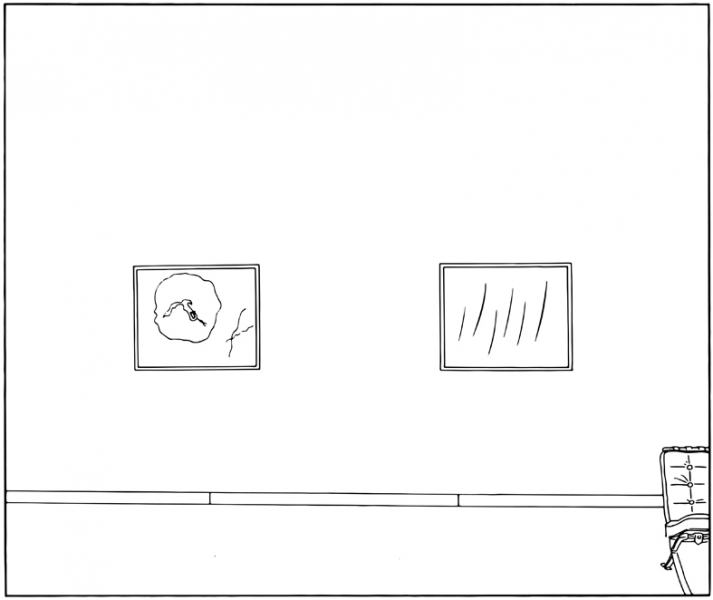
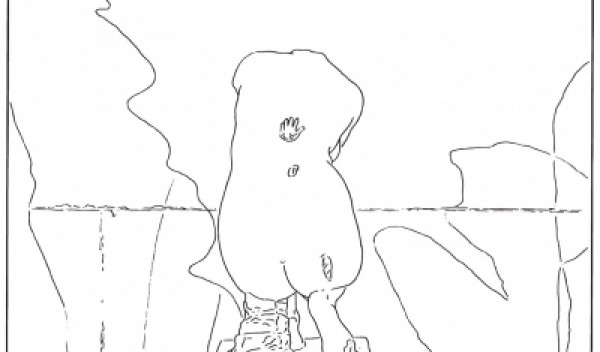
Traced directly from her photographs, and made in collaboration with the artist and children’s book illustrator Jon Buller, the ‘tracings’ are black-and-white line drawings that are converted to a vector graphic and printed on a vinyl that is adhered directly to the wall. Each edition exists as an adaptable digital file that can be printed at any size. The particular group of tracings exhibited on this occasion, for instance, have been produced to adapt to the large walls of the Berlin gallery. A ‘tracing’ takes material form only when exhibited, and it can be destroyed and remade in a different size for its next presentation. Some of the works in the show are editions of 10, while others are unlimited editions.
The largest work in the show is Pollock and Tureen (traced) (1984 / 2013), a ‘tracing’ of Lawler’s iconic photograph Pollock and Tureen(1984). The original work is a medium-sized photograph, just under a metre wide, that portrays a decorative piece of porcelain placed on a shelf beneath the expressive splatters of a Pollock. Pollock and Tureen (traced) has been enlarged to almost ten metres to occupy a substantial section of one of the long gallery walls. At this scale, many of the lines in the vector drawing start to behave less predictably, often taking on a form of their own when viewed up close. Viewed from afar, the picture again coheres into a recognisable image. Each ‘tracing’ becomes both a representation of a previous artwork and an ephemeral installation in a particular space, expanding the conceptual foundations of pictures. Writing in the Museum Ludwig catalogue, Philip Kaiser describes the ‘tracings’ as ‘skeletons’ that explore ‘the extreme ends and corners of pictures and their contexts.’










 INFERNO