AYANA V. JACKSON, ARTISTE ENGAGÉE DE LA FIGURE DE LA FEMME COMME LIEU DE POUVOIR, CHEZ MARIANE IBRAHIM
AYANA V. JACKSON – « I Would Follow Her by Ground and Sea » – Galerie Mariane Ibrahim Paris – 22 janvier – 14 mars 2026
Mariane Ibrahim présente I Would Follow Her by Ground and Sea, une exposition d’œuvres d’Ayana V. Jackson. Réunissant des ensembles majeurs de son travail, l’exposition retrace l’engagement constant de l’artiste autour de la figure de la femme, envisagée comme un lieu de mémoire, de pouvoir et de projection vers l’avenir.
Au rez-de-chaussée de la galerie sont présentées trois œuvres issues de la série From the Deep: In the Wake of Drexciya. Dévoilée en 2023 lors de l’exposition personnelle de Jackson au Smithsonian National Museum of African Art à Washington, D.C., cette série s’inspire de Drexciya, duo techno de Detroit qui a développé un univers mythologique centré sur une civilisation sous-marine née des femmes africaines enceintes jetées par-dessus bord, ou ayant sauté à la mer, durant la traite transatlantique. Le mythe fondateur de Drexciya réinvestit ainsi l’abîme non comme un lieu d’anéantissement, mais de transformation.
S’inscrivant dans cette filiation spéculative, Jackson construit une aquatopie sacrée dans laquelle les images confrontent la brutalité qui a condamné des millions de personnes à la mer, tout en imaginant un monde façonné par des femmes puissantes et résilientes. En mobilisant son propre corps comme sujet et comme médium, l’artiste met en scène une enquête incarnée sur l’absence historique, la perte et la survie, opérant un renversement du regard et interrogeant ce que ces histoires englouties pourraient voir lorsqu’elles nous regardent à leur tour.
En août 2025, soit deux ans après la présentation inaugurale de From the Deep: In the Wake of Drexciya, le travail de Jackson a été explicitement cité par l’administration américaine actuelle dans une liste d’œuvres jugées problématiques. Cet épisode souligne l’urgence et la pertinence durable de sa pratique, qui affirme la nécessité de faire exister l’histoire précisément là où elle demeure contestée, inconfortable ou délibérément occultée.
À l’étage, l’exposition s’enrichit d’œuvres issues des séries Dear Sarah (2016) et You Forgot to See Me Coming (2023), qui prolongent l’engagement de Jackson à revisiter l’histoire par le biais de l’auto-représentation performative. Dans Dear Sarah, l’artiste examine l’identité fragmentée de Sarah Forbes Bonetta, figure du XIXᵉ siècle réduite en esclavage par le royaume du Dahomey avant de devenir la protégée et filleule de la reine Victoria. Chaque image traverse les noms et les rôles successivement imposés à Sarah, révélant les violences et les contradictions inhérentes aux processus de nomination, de protection et d’assimilation.
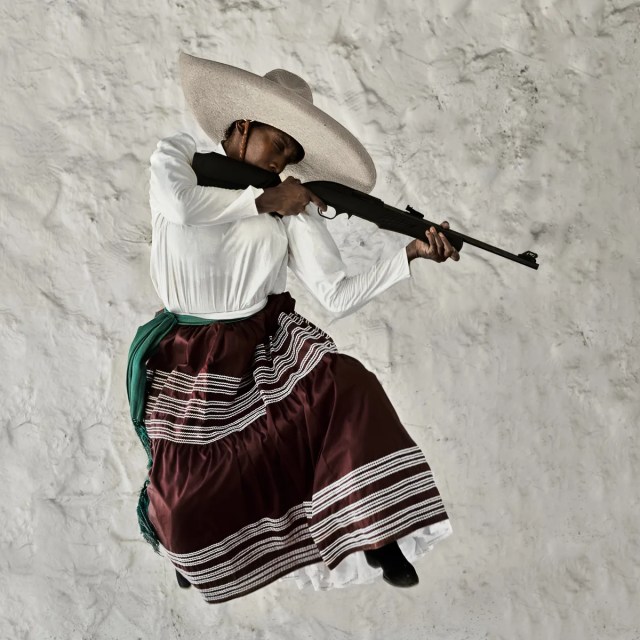
Les photographies issues de You Forgot to See Me Coming, série développée lors de la résidence de Jackson à la Alturas Foundation, explorent les croisements entre les histoires des femmes noires et autochtones dans les conflits armés du début du XXᵉ siècle, notamment la Révolution mexicaine. En convoquant des figures telles que Carmen Robles — colonelle afro-descendante ayant combattu aux côtés de l’armée zapatiste — Jackson confronte des historiographies racialisées profondément ancrées et la tendance persistante à minimiser le rôle fondamental des femmes dans les mouvements de libération.
À travers ses différents chapitres, l’exposition affirme la nécessité de la présence, du travail et de la pensée d’Ayana V. Jackson. En opposant la représentation à la représentation elle-même, l’artiste rappelle que l’art demeure un vecteur essentiel de résistance, et que la mémoire — aussi douloureuse ou inachevée soit-elle — doit continuer à être activée, défendue et réinventée.
______________________
Mariane Ibrahim presents ‘I Would Follow Her by Ground and Sea’, an exhibition by Ayana V. Jackson. Bringing together key bodies of work from across her practice, the exhibition traces Jackson’s sustained engagement with the figure of the woman as a site of memory, power, and futurity.
On the gallery’s lower ground floor, the presentation centers on three major pieces from From the Deep: In the Wake of Drexciya. First shown in 2023 in the artist’s critically acclaimed solo exhibition at the Smithsonian National Museum of African Art in Washington, D.C., this series is inspired by Drexciya, the Detroit-based techno duo active in the early 1990s who developed a sonic and mythological universe centered on an underwater civilization inhabited by the descendants of pregnant African women thrown overboard, or who leapt into the ocean, during the transatlantic slave trade. Drexciya’s founding myth reclaims the abyss not as a site of annihilation, but of transformation.
Drawing from this speculative lineage, Jackson constructed a sacred aquatopia in which the images ask us to reckon with the brutality that consigned millions to the sea, while simultaneously envisioning a world shaped by powerful and resilient women. Using her own body as both subject and conduit, Jackson stages an embodied inquiry into historical absence, loss, and survival, inviting a reversal of the gaze that asks what these submerged histories might see when they look back at us.
In August 2025, two years after the debut of From the Deep: In the Wake of Drexciya, Jackson’s work was explicitly cited by the current American administration in a publicly circulated list of artworks deemed objectionable, following official statements accusing the Smithsonian institutions of being “out of control”. This recent episode underscores the urgency and continued relevance of Jackson’s practice—one that insists on history precisely where it is contested, uncomfortable, or deliberately suppressed.
Upstairs, the exhibition expands to include works from Dear Sarah (2016) and You Forgot to See Me Coming (2023), two series that further articulate Jackson’s commitment to revisiting history through performative self-representation. In Dear Sarah, Jackson examines the fragmented identity of Sarah Forbes Bonetta, a nineteenth-century figure enslaved by the Kingdom of Dahomey who later became the protégée and goddaughter of Queen Victoria. Each photograph navigates the shifting names and roles imposed upon Sarah throughout her life, prompting reflection on the violence and contradictions embedded in acts of naming, protection, and assimilation.
Facing these works are photographs from You Forgot to See Me Coming, a series developed during Jackson’s residency at the Alturas Foundation. Here, the artist explores the intersections of Black and Indigenous women’s histories within early twentieth-century armed conflicts, notably the Mexican Revolution. Drawing on archival references and period characterization, the works introduce levity as a strategic and disarming force. By invoking figures such as Carmen Robles—an Afro-descendant colonel who fought alongside the Zapatista army—Jackson confronts entrenched racist historiographies and the broader tendency to overlook women’s fundamental roles in liberation movements.
By fighting representation with representation itself, Ayana V. Jackson reminds us that art remains a vital vessel of resistance, and that memory—however painful or unresolved—must continue to be activated, defended, and reimagined.
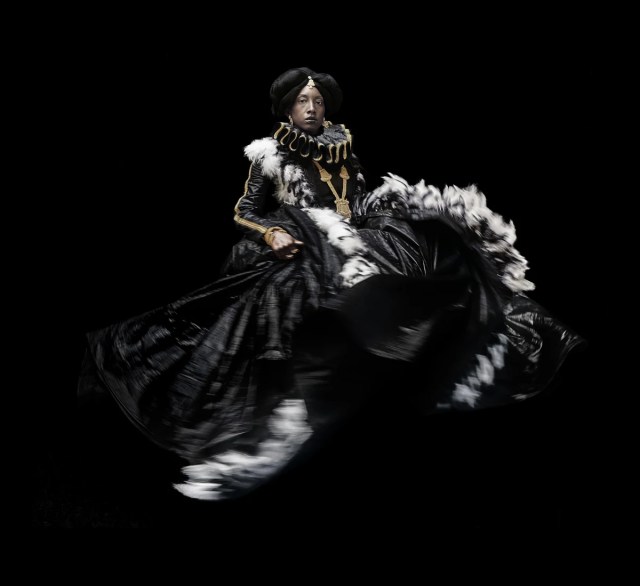
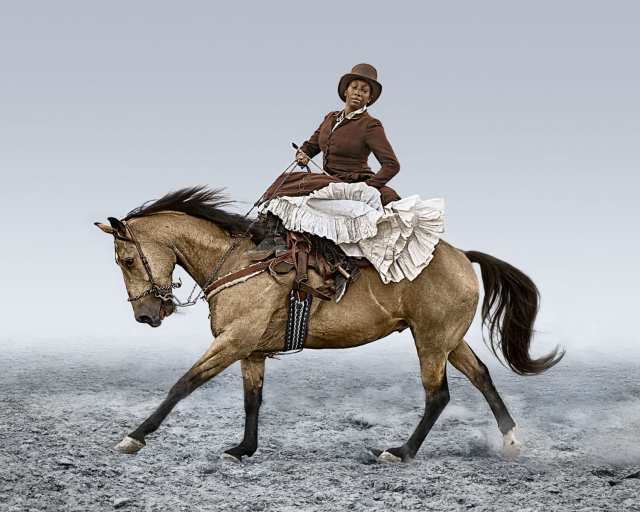
Images: 1- Ayana V. Jackson, ‘Adelita: She was not only Brave she was Beautiful’, 2023 – 2- Ayana V. ‘Jackson Consider the sky and the sea’, 2019 – 3- Ayana V. Jackson ‘To be Black and Female in The spanish south-west, in the style of Selika Lazevski, 2023 – All images copyright the artist and Mariane Ibrahim gallery











 INFERNO