AMOAKO BOAFO, L’ARTISTE QUI N’HÉSITE PAS À DONNER DANS LA DENTELLE
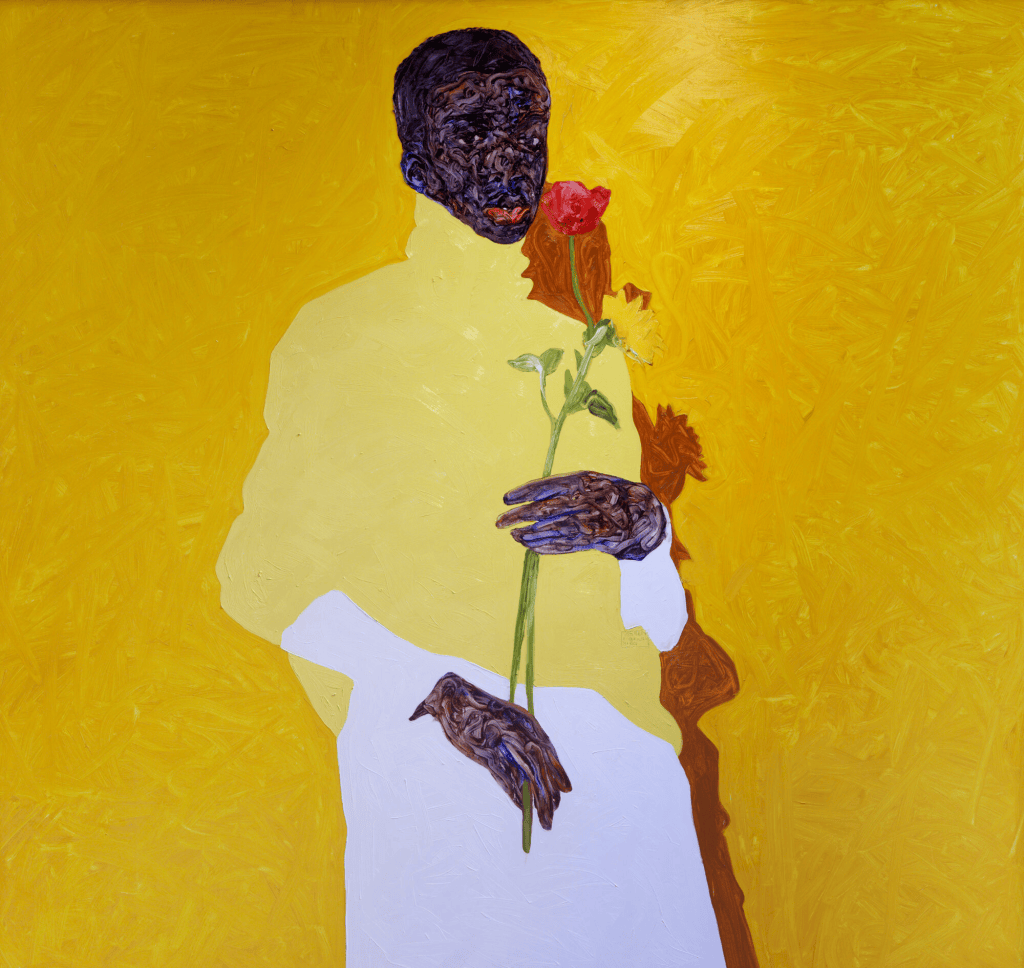
AMOAKO BOAFO – The home I have never had – Galerie Mariane Ibrahim, Paris – Jusqu’au 19 décembre 2026.
The Home I Have Never Had est la quatrième exposition personnelle d’Amoako Boafo chez Mariane Ibrahim. Pensée comme un intérieur habité, elle réunit des peintures récentes, dont certaines intègrent la broderie, ainsi que des œuvres plus anciennes datant de 2016. Loin de suivre un parcours chronologique, l’exposition s’organise autour des liens qui unissent les personnes représentées : amis, confidents et l’artiste lui-même. Ensemble, ces portraits dessinent les contours d’une famille choisie, où l’affection et le sentiment d’appartenance constituent les fondements du foyer que Boafo imagine.
Au fil des années, l’artiste a développé un langage pictural aussi singulier qu’expressif. Sur des fonds traités en larges aplats de couleurs franches, la peau fait l’objet d’un travail de la matière beaucoup plus physique. Dans ses œuvres les plus récentes, cette approche tactile se prolonge dans la broderie, intégrée directement à la toile pour évoquer les dentelles finement ouvragées des robes de mariée. La précision du travail à l’aiguille vient ainsi dialoguer avec la spontanéité du geste pictural, donnant une place nouvelle au savoir-faire artisanal dans sa peinture.
Ce langage s’est progressivement déployé au-delà de la toile. Bois sombre, textiles, papiers à motifs et mobilier prolongent désormais l’univers des personnages dans l’espace qui les entoure. Avec The Home I Have Never Had, cette évolution prend une dimension architecturale : la galerie se métamorphose en un intérieur accueillant, chaleureux, empreint d’émotion, qui ne cherche pas à reproduire la maison de l’artiste, mais à donner corps à un foyer rêvé. Le titre recèle ainsi un paradoxe : ce foyer que Boafo n’a jamais eu, il peut pourtant le créer et l’emporter avec lui. Un lieu à soi, mais dont la porte reste ouverte aux autres.
Dans la salle principale, deux couples de jeunes mariés, une mariée et un groupe d’amis semblent réunis pour une même célébration. Dans The Couple I et The Couple II, les couples se détachent sur des fonds verts, tandis que White Suits rassemble cinq personnages vêtus de blanc. Ce vert récurrent suggère la présence d’un jardin, lieu de rencontre et de convivialité où les amis se retrouvent.
À l’étage, on quitte symboliquement cet espace partagé pour pénétrer dans la chambre. À l’effervescence de la réunion succède une intimité plus feutrée. Dans Self Portrait, Boafo se représente allongé sur un lit ; dans Self Portrait At Peace, il disparaît presque sous des draps à motifs. Mais la chambre n’est pas seulement un lieu où se retirer du monde : elle est aussi un refuge depuis lequel l’artiste observe ce qui l’entoure. Les corps alanguis et les portraits de femmes y insufflent unesensualité discrète, faisant de cet espace un lieu où se mêlent contemplation et désir. Boafo y est tout autant celui qui regarde que celui qui s’expose au regard, nous laissant entrevoir son univers intime tout en nous observant à son tour, en silence.
L’autoportrait occupe depuis longtemps une place essentielle dans son travail. Revenant sur son arrivée à Vienne, Boafo raconte avoir commencé à se représenter plus souvent, convaincu qu’il lui fallait d’abord apprendre à se connaître pour avoir quelque chose à offrir aux autres. Mais cette quête de soi ne s’arrête pas à sa propre image : « Quand je pense aux autres personnages, je me dis : “Cela pourrait être moi.” » C’est peut-être là que se trouve l’une des clés de The Home I Have Never Had. Pour Boafo, le foyer ne se définit pas par ce que l’on possède, mais par les liens qui nous unissent : cette capacité à se reconnaître dans les autres et à construire, ensemble, un lieu où l’on se sente chez soi.
Amoako Boafo (né en 1984 à Accra, Ghana ; vit et travaille au Ghana) est connu pour son approche innovante de la représentation des corps noirs, en reformulant et en réalignant leurs dispositions malgré le contexte global plus large qui entoure la culture noire. Reconnu pour ses portraits séduisants peints au doigt, le travail de Boafo est devenu une référence au sein du champ pictural de l’histoire de l’art.
À travers des portraits saisissants, souvent monochromes et directs, Boafo établit une proximité intime avec ses sujets. Les figures regardent le spectateur avec fermeté, affichant des dispositions résolues. Généralement isolés sur des fonds monochromes, les spectateurs n’ont d’autre endroit où regarder que les sujets, laissant peu de place à la mauvaise interprétation. Ses tableaux vivants sont élevés à un niveau de grande reconnaissance, à la fois physiquement par leur échelle et spirituellement par leur grandeur.
Son travail a été exposé dans des institutions telles que le Belvedere Museum (Vienne, Autriche), Bozar – Centre for Fine Arts (Bruxelles, Belgique), la Kunsthalle Wien (Vienne, Autriche), le Kunstmuseum Basel (Bâle, Suisse), le Seattle Art Museum (Seattle, Washington), le Denver Art Museum (Denver, Colorado), le Museum of the African Diaspora (San Francisco, Californie), le Wooyang Museum of Contemporary Art (Gyeongju, Corée du Sud) et le Zeitz Museum of Contemporary Art Africa (Zeitz MOCAA) (Le Cap, Afrique du Sud), entre autres.
____________________
AMOAKO BOAFO – The home I have never had – Mariane Ibrahim Gallery, Paris – Until december 19, 2026.
The Home I Have Never Had marks Amoako Boafo’s fourth solo exhibition with Mariane Ibrahim. Conceived as a domestic interior, the exhibition brings together new paintings incorporating embroidery, alongside earlier works dating back to 2016. Rather than following a chronology, their arrangement reflects an intimate constellation of relationships: friends, confidants, and the artist himself. Together, they form a portrait of a chosen community, one in which affection and belonging become the very foundations of the home Boafo imagines.
The artist has developed an eloquent and immediately recognizable pictorial vocabulary. Layered on backgrounds of broad brushstrokes of solid color, the skin is reinforced through a far more physical process. In his most recent works, his tactile approach to painting extends to embroidery, which he incorporates directly into the canvas to evoke the intricate lace of bridal gowns. This introduces another dimension of craftmanship to his practice, bringing the meticulous gestures of needlework into dialogue with the physical immediacy of his painting.
In recent years, this vocabulary has expanded beyond the canvas. Dark wood, textiles, patterned papers, and furniture extend the world of his subjects into the space around them. In The Home I Have Never Had, this relationship takes on an architectural dimension: the gallery becomes an enveloping interior that, rather than reproducing the artist’s own home, imagines a warm and emotionally resonant one. The title thus contains a paradox: this is the home Boafo has never had and yet is able to build and carry with him, an intimate space open to others.
In the main gallery, two newlywed couples, a bride, and a group of friends seem to come together as part of the same celebration. The characters in The Couple I and The Couple II are placed against green backgrounds, while White Suits brings together five figures dressed in white. The green that recurs behind them evokes a garden, a shared space where friends gather.
On the second floor, the exhibition moves symbolically from a shared space and into the bedroom. The collective scale of the gathering gives way to another form of intimacy. Boafo appears lying in bed in Self Portrait and almost disappears beneath the patterned sheets of Self Portrait At Peace. Yet the bedroom is more than a space of retreat, becoming a refuge and an observatory of the world. The reclining figures and portraits of women introduce a sensual dimension, a space where contemplation and desire coexist. The artist is both observer and observed, inviting us into his private world while quietly returning our gaze.
Self-portraiture has accompanied the artist for years. Recalling his arrival in Vienna, Boafo has explained that he began painting himself more frequently because he felt he needed to know himself before he could offer much to others. Yet this identification does not end with his own image: “When I think of other characters, I think, ‘This could be me.’” Perhaps this is one of the keys to The Home I Have Never Had. The home Boafo imagines is defined not by ownership, but by recognition: by the possibility of seeing oneself in those around us and, with them, building a place to belong.
Amoako Boafo (b. 1984 in Accra, Ghana; lives and works in Ghana) is known for his innovative approach to the presentation of Black bodies; reframing and realigning their dispositions despite the larger global context surrounding Black culture. Acclaimed for his enticing finger-painted portraits, Boafo’s work has become landmarked within the pictorial subset of art history.
Through striking, often monotone and direct portraits, Boafo engages in an intimate closeness with his subjects. The figures gaze with firmness as they look toward the viewer with resolute dispositions. Typically isolated against single-color backgrounds, viewers have nowhere to look but at the subjects, leaving little room for misinterpretation. His tableaux vivants are elevated to a place of high recognition, both physically through their scale and spiritually through their grandeur.
His work has been exhibited at institutions including the Belvedere Museum (Vienna, Austria), Bozar – Centre for Fine Arts (Brussels, Belgium), Kunsthalle Wien (Vienna, Austria), Kunstmuseum Basel (Basel, Switzerland), the Seattle Art Museum (Seattle, WA), the Denver Art Museum (Denver, CO), the Museum of the African Diaspora (San Francisco, CA), the Wooyang Museum of Contemporary Art (Gyeongju, South Korea), and the Zeitz Museum of Contemporary Art Africa (Zeitz MOCAA) (Cape Town, South Africa), among others.
______________________
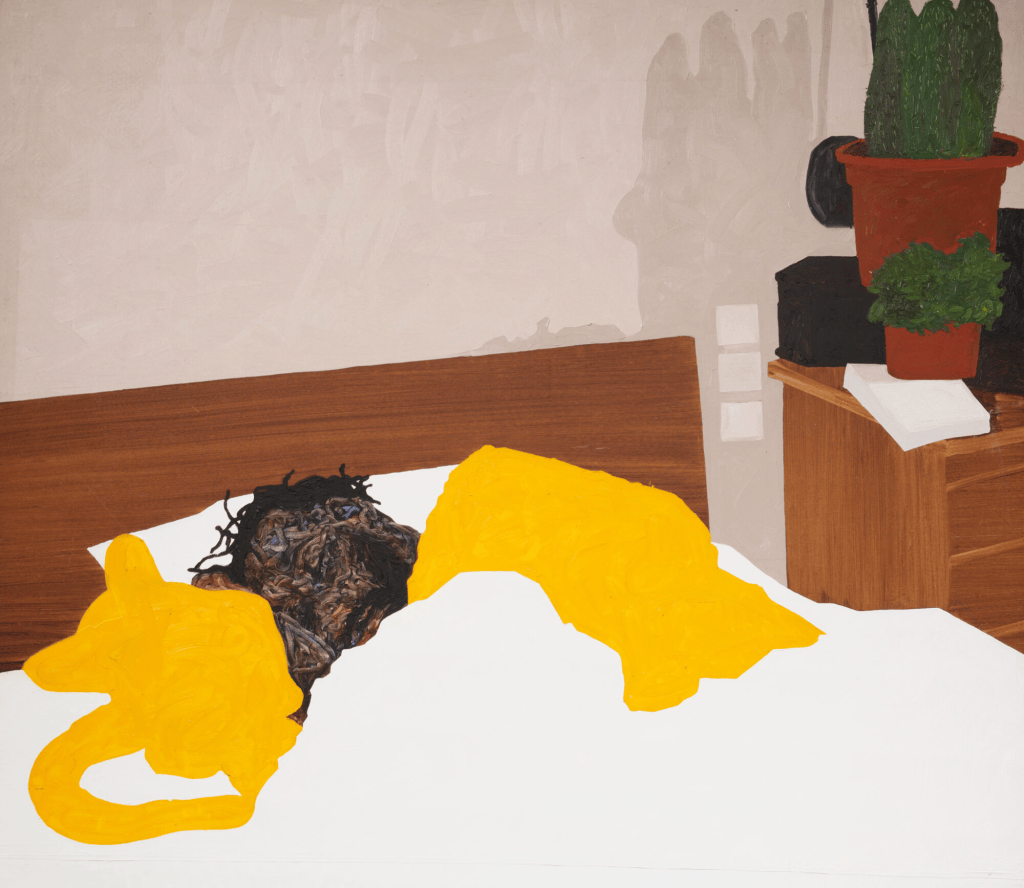
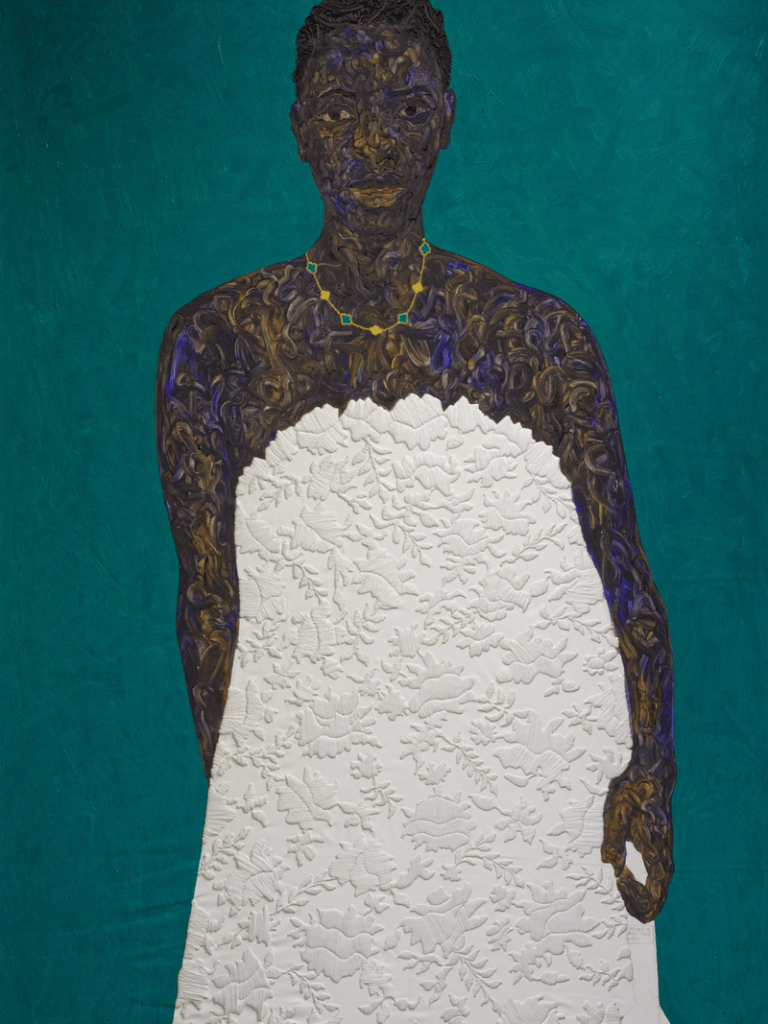
Images: 1- Amoako Boafo, Yellow Turtleneck, 2021, huile sur toile, 198,5 × 208 cm. Courtesy de l’artiste et de Mariane Ibrahim. Photo : Aurélien Mole – 2- Amoako Boafo, Self Portrait, 2025-2026, huile sur toile, 180 × 205 cm. Courtesy de l’artiste et de Mariane Ibrahim. Photo : Aurélien Mole – 3- Amoako Boafo, Malachite and Gold Alhambra, 2026. Photo by Aurélien Mole. Courtesy of the artist and Mariane Ibrahim