VENISE. LA BEAUTÉ ABSOLUE DE « THIRD PERSON », L’EXPOSITION DE LORNA SIMPSON, PUNTA DELLA DOGANA
Venise, envoyé spécial.
LORNA SIMPSON – Third Person – Punta delle Dogana, Collection Pinault Venise – Jusqu’au 22 novembre 2026.
“I’m taking a liberty with something that is already malleable; that gets assigned a meaning. I just assign it a different meaning.” – Lorna Simpson*
De l’autre côté du grand canal, presque en face de Palazzo Grassi, se trouve l’autre espace d’exposition de la Collection Pinault qui cette année a décidé de consacrer un temps fort à Lorna Simpson et Paulo Nazareth.
Emma Lavigne, directrice et conservatrice générale de la Collection Pinault, a orchestré en collaboration avec le Metropolitan Museum of Art de New York la plus importante exposition de Lorna Simpson en Europe. Il convient de noter qu’une première version de ce projet, intitulée Source Notes, a été présentée dans le musée new-yorkais en 2025. À Venise, le parcours déploie une cinquantaine d’œuvres — peintures, collages, sculptures, installations et vidéos — enrichies de nouvelles créations spécialement conçues pour interagir avec l’architecture de la Punta della Dogana.
EASY TO REMEMBER
Photographe et plasticienne, Lorna Simpson est née à Brooklyn en 1960. Elle grandit au sein d’une famille d’origines afro-américaine et cubano-jamaïcaine qui éveille très tôt sa sensibilité artistique. Son parcours académique d’excellence conjugue des écoles d’art prestigieuses de la côte Est et de la côte Ouest des États-Unis. C’est durant ses études à San Diego qu’elle commence à contester la prétendue objectivité de la « photographie documentaire ». Inspirée par l’art conceptuel, elle choisit de ne plus simplement « capturer le réel », mais de juxtaposer ses images à des textes afin de déconstruire les stéréotypes de genre et de race. Dès l’obtention de son diplôme en 1985, elle s’impose auprès de la critique comme une pionnière de la photographie conceptuelle américaine, interrogeant avec acuité les mécanismes de construction des images.
Au milieu des années 2010, la peinture s’impose comme un nouveau champ d’exploration particulièrement fécond. Elle y prolonge les questions fondamentales qui irriguent toute son œuvre : l’érosion et les résurgences de la mémoire, les failles de la représentation ou encore l’instabilité des récits. Depuis une quinzaine d’années, le collage occupe également une place centrale dans son processus créatif. L’eau, le feu, la glace, la poussière, les météorites et les nuages deviennent alors autant de motifs poétiques que le public découvre ici dans toute leur dimension.
Passé l’effet toujours saisissant de ces grands volumes de briques, la première salle dévoile des sérigraphies à l’encre du début des années 2000. Avec des pièces comme Quotation Marks, Then & Now, Black Nebula ou Three Figures, le visiteur plonge tête la première dans l’univers de l’artiste avec cette échelle qui semble nous projeter vers un nuage d’encre noire, suspendu au-dessus d’un précipice vertigineux. Au beau milieu de l’espace, la sculpture Stack — une colonne monumentale de magazines anciens — matérialise un besoin de rêve et d’évasion, tout en ancrant sa source d’inspiration dans notre quotidien le plus brut.
Au fond de la première salle, un film défile avec une bande son d’un sifflet dans le brouillard. C’est à la fois poétique et inquiétant mais on se laisse absorber par cette idée de vagabondage.
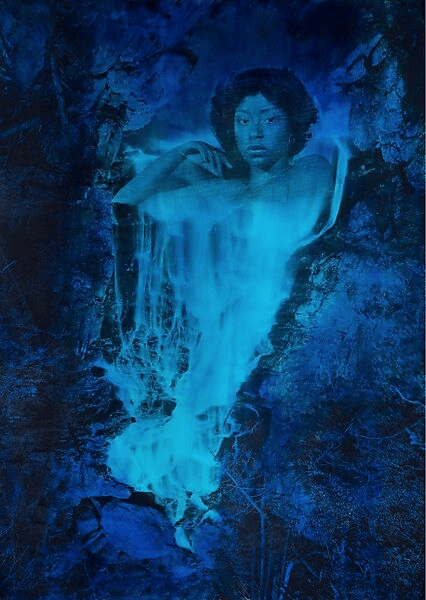
Dans la seconde salle, l’émotion se fait plus vibrante encore. En écho aux ardoises de Lee Ufan installées cette année dans la grande chapelle du Palais des Papes d’Avignon, la pièce Vibrating Cycles dévoile une dizaine de bols tibétains en porphyre, disposés sur un empilement de tuiles d’argile. Une personne chargée de les faire sonner confère un supplément d’âme aux portraits géants de femmes noires qui l’entourent. Ces visages aux chevelures afro, déclinés en bleus nocturnes et gris givrés, produisent un effet garanti.
Plus loin, faisant face à une fenêtre, se dresse 5 Properties : un petit tabouret supportant une pile de feuilles et de livres surmontée d’un buste de femme noire en bronze et en plâtre. Juste en dessous, un cube de verre évoque un gros glaçon transparent.
On découvre également Ice 4, un mélange magistral de peinture et de collage où le visage d’une femme est recouvert d’un aplat blanc. Ce voile de matière place la question de l’invisibilisation sociale au cœur de la toile.
À l’étage, le spectateur est frappé par la série Special Characters, quatre sérigraphies qui rappellent furieusement le travail d’Andy Warhol. Des éclats de rose vif, de jaune cadmium et de rouge intense viennent recouvrir de vieilles publicités de perruques afro, publiées entre les années 1950 et 1970 dans le célèbre magazine américain Ebony.
Dans la rotonde qui surplombe le canal, il ne faut pas manquer Woman on a Snowball. Cette sculpture en bronze et plâtre représente une femme assise, se tenant le genou – tête noire, jambe blanche – soudée dans une sphère d’un blanc marial. Elle confirme le talent de l’artiste à magnifier le corps humain tout en l’extrayant du quotidien à travers des installations improbables, révélant des situations de fragilité et de précarité.
Enfin, l’installation vidéo sur deux canaux Easy to Remember filme au plus près les lèvres de quinze chanteurs, associées à des images d’archives de crânes. Le rythme est dicté par un chœur fredonnant à l’unisson la célèbre mélodie de John Coltrane. Leurs bouches closes exhalent un murmure qui crée une atmosphère sonore intime, envoûtante et mélancolique. L’œuvre juxtapose avec force la douceur de la voix humaine et la dureté de la mort. C’est un travail poignant sur la mémoire collective, le deuil et ce qui persiste à travers l’histoire afro-américaine.
Cette exposition est d’une beauté absolue, à la fois inspirante et dérangeante. Elle dialogue d’ailleurs harmonieusement avec les œuvres de Paulo Nazareth, qui occupe le second étage de la Punta della Dogana.
Emmanuel Serafini, envoyé spécial à Venise
*« Je prends une liberté avec quelque chose qui est déjà malléable, à quoi l’on attribue un sens. Je lui attribue simplement un sens différent. »
_____________________________________
LORNA SIMPSON – Third Person – Punta delle Dogana, Collection Pinault Venise – Until 22 November 2026.
“I’m taking a liberty with something that is already malleable; that gets assigned a meaning. I just assign it a different meaning.” – Lorna Simpson
On the other side of the Grand Canal, almost opposite Palazzo Grassi, is the other exhibition space of the Pinault Collection, which this year has decided to dedicate a significant portion of its exhibition to Lorna Simpson and Paulo Nazareth.
Emma Lavigne, director and chief curator of the Pinault Collection, orchestrated, in collaboration with the Metropolitan Museum of Art in New York, the most important Lorna Simpson exhibition in Europe. It is worth noting that an earlier version of this project, titled Source Notes , was presented at the New York museum in 2025. In Venice, the exhibition features some fifty works—paintings, collages, sculptures, installations, and videos—enriched by new creations specifically designed to interact with the architecture of the Punta della Dogana.
EASY TO REMEMBER
Photographer and visual artist Lorna Simpson was born in Brooklyn in 1960. She grew up in a family of African American and Cuban-Jamaican descent, which awakened her artistic sensibilities at a very young age. Her academic path of excellence combined prestigious art schools on both the East and West Coasts of the United States. It was during her studies in San Diego that she began to challenge the supposed objectivity of « documentary photography. » Inspired by conceptual art, she chose to no longer simply « capture reality, » but to juxtapose her images with texts in order to deconstruct gender and racial stereotypes. Upon graduating in 1985, she established herself among critics as a pioneer of American conceptual photography, acutely questioning the mechanisms of image construction.
In the mid-2010s, painting emerged as a particularly fruitful new field of exploration. It allowed her to extend the fundamental questions that permeate her entire body of work: the erosion and resurgence of memory, the flaws in representation, and the instability of narratives. For the past fifteen years, collage has also occupied a central place in her creative process. Water, fire, ice, dust, meteorites, and clouds become poetic motifs that the public discovers here in all their complexity.
Beyond the ever-striking effect of these large brick volumes, the first room reveals ink screen prints from the early 2000s. With pieces like Quotation Marks , Then & Now , Black Nebula , and Three Figures , the visitor is plunged headfirst into the artist’s universe by a scale that seems to propel us toward a cloud of black ink, suspended above a vertiginous precipice. In the very center of the space, the sculpture Stack —a monumental column of old magazines—embodies a need for dreams and escape, while simultaneously grounding its source of inspiration in the rawest aspects of our daily lives.
At the back of the first room, a film plays with a soundtrack of a whistle in the fog. It’s both poetic and unsettling, but you find yourself absorbed by this idea of wandering.
In the second room, the emotion becomes even more palpable. Echoing Lee Ufan’s slate installations set up this year in the grand chapel of the Palais des Papes in Avignon, the piece Vibrating Cycles features a dozen Tibetan porphyry singing bowls arranged on a stack of clay tiles. A person playing them adds a further dimension to the giant portraits of Black women surrounding them. These faces with their Afro hairstyles, rendered in nocturnal blues and frosted grays, produce a truly striking effect.
Further on, facing a window, stands 5 Properties : a small stool supporting a stack of papers and books, topped by a bronze and plaster bust of a Black woman. Just below, a glass cube evokes a large, transparent ice cube.
We also discover Ice 4 , a masterful blend of painting and collage where a woman’s face is covered with a flat white layer. This veil of matter places the issue of social invisibility at the heart of the canvas.
Upstairs, the viewer is struck by the Special Characters series , four screen prints that strongly recall the work of Andy Warhol. Splashes of bright pink, cadmium yellow and intense red cover old advertisements for afro wigs, published between the 1950s and 1970s in the famous American magazine Ebony .
In the rotunda overlooking the canal, don’t miss Woman on a Snowball . This bronze and plaster sculpture depicts a seated woman, holding her knee—black head, white leg—fused within a sphere of pristine white. It confirms the artist’s talent for magnifying the human body while simultaneously extracting it from the everyday through improbable installations, revealing situations of fragility and precariousness.
Finally, the two-channel video installation Easy to Remember films the lips of fifteen singers in close-up, juxtaposed with archival images of skulls. The rhythm is dictated by a choir humming John Coltrane’s famous melody in unison. Their closed mouths exhale a murmur that creates an intimate, haunting, and melancholic soundscape. The work powerfully juxtaposes the tenderness of the human voice with the harshness of death. It is a poignant exploration of collective memory, grief, and what endures throughout African American history.
This exhibition is absolutely beautiful, both inspiring and unsettling. It also engages in a harmonious dialogue with the works of Paulo Nazareth, which occupy the second floor of the Punta della Dogana.
Emmanuel Serafini , special correspondent in Venice
____________________________________________
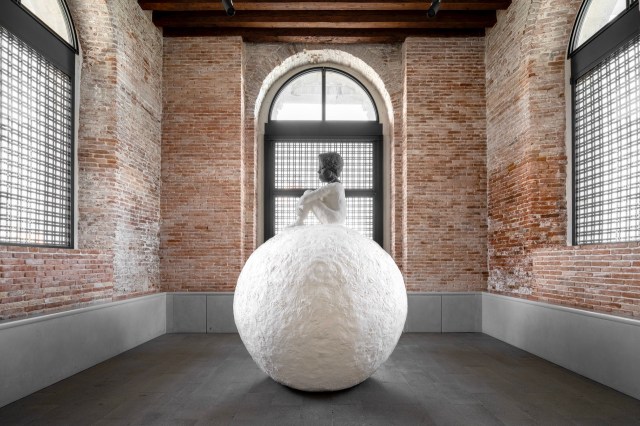
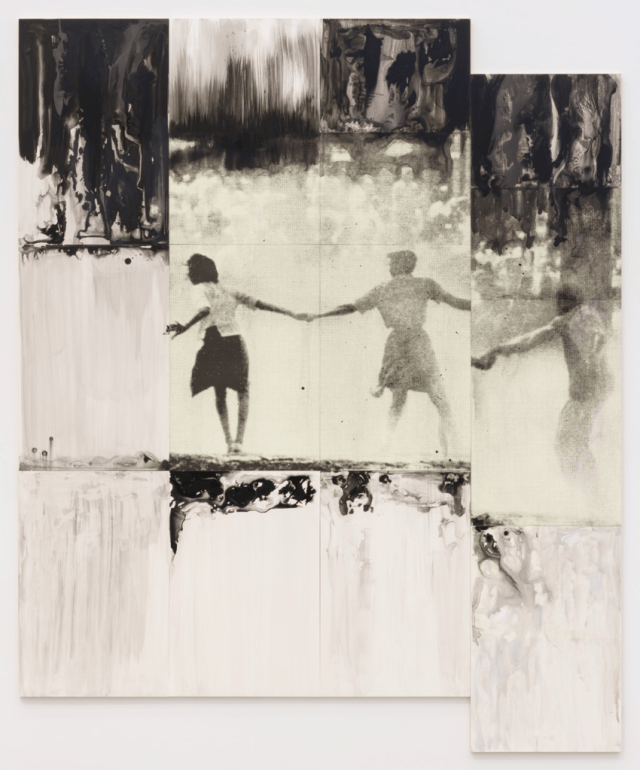
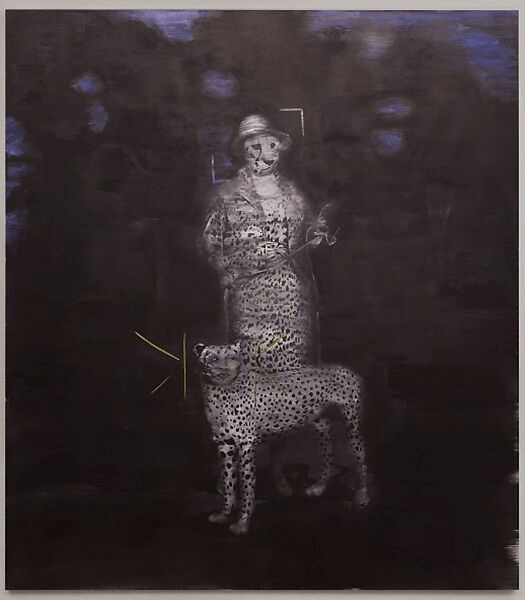
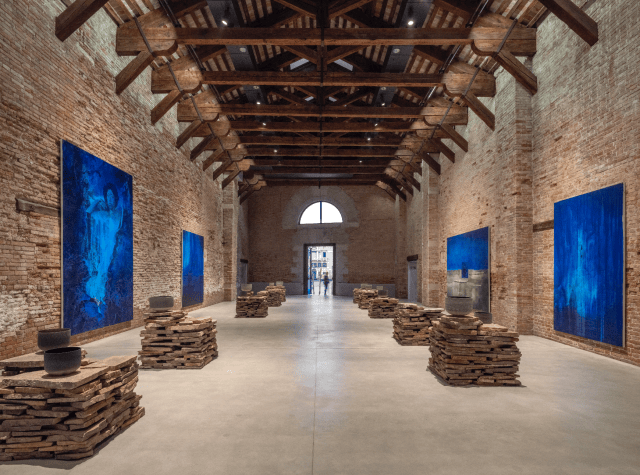
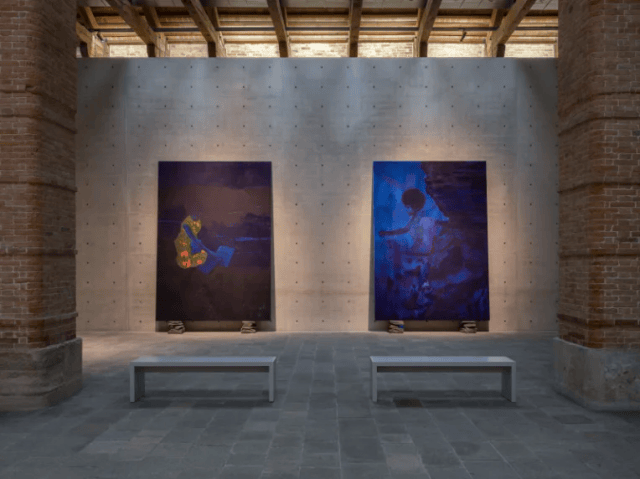
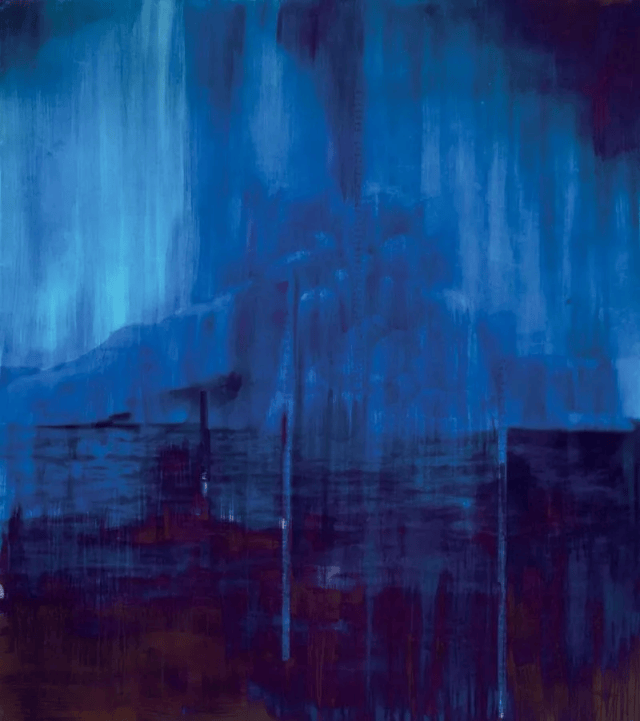
Images: 1- Night Fall, acrylic on gessoed wood, 2023, courtesy of the artist and Hauser & Wirth. Installation views, Lorna Simpson. Third Person, 2026, Punta della Dogana, Venezia. Ph. James Wang – 2- Lorna Simpson, Woman on a Snowball, 2018, sculpture. « Trois perspectives sur l’art du présent » à Punta della Dogana, 2020 © Palazzo Grassi, photographie Marco Cappelletti – 3- Lorna Simpson, Three figures, 2014, photo James Wang – 4- Lorna Simpson, True Value, ink and acrylic on gessoed wood, 2015, particular collection – 5- Lorna Simpson, Tried by Fire (detail), 2017, courtesy of the artist and Hauser & Wirth. Installation views, Lorna Simpson. Third Person, 2026, Punta della Dogana, Venezia. Ph. James Wang © Palazzo Grassi, Pinault Collection – 4- exhibition view, Punta della Dogana : Lorna Simpson, Vibrating cycles, 2026, Courtesy of the artist and Hauser & Wirth (wall, from left to right) Lorna Simpson, Night Fall, 2023, Private Collection; Thin Bands, 2019, Courtesy of the artist and Hauser & Wirth; Time, 2021, Private Collection; Howling, 2020, Gina and Stuart Peterson Collection, photo James Wang – 5- Lorna Simpson, L.A., 2025, courtesy of the artist and Hauser & Wirth; Cliffs, 2025, Pinault Collection Installation views, Lorna Simpson. Third Person, 2026, Punta della Dogana, Venezia. Ph. James Wang © Palazzo Grassi, Pinault Collection – 6- Vibrating cycles, 2026, Courtesy of the artist and Hauser & Wirth – All images copyright Lorna Simpson and Hauser & Wirth, Pinault Collection Venice – All images copyright Lorna Simpson and Hauser & Wirth, Pinault Collection Venice – Courtesy the artist, Hauser & Wirth, Pinault collection Venice, Botta Veneta 2026.