VENISE. PAULO NAZARETH, LA MÉMOIRE DE RÉCITS INVISIBLES QUI REFONT SURFACE ICI, SUR LA LAGUNE ÉTERNELLE
Venise, envoyé spécial.
PAULO NAZARETH – Algebra – Punta delle Dogana, Collection Pinault, Venise – Jusqu’au 22 novembre 2026.
TUMBEIRO
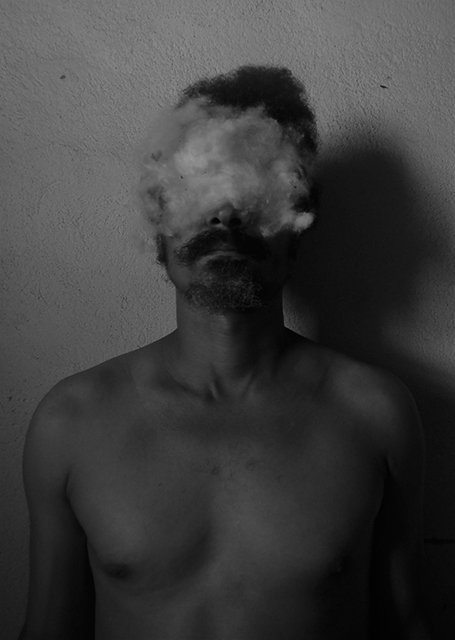
Né en 1977 à Governador Valadares, Paulo Nazareth est un artiste plasticien brésilien reconnu pour son engagement. Il vit et travaille aujourd’hui à Belo Horizonte au Brésil. Sa démarche fusionne intimement l’art et l’existence : il réalise de longues marches, souvent nu-pieds, pour interroger l’histoire coloniale, le racisme et les tensions sociales en Amérique et en Afrique. Diplômé de l’Université fédérale du Minas Gerais, il combine performance, vidéo, photographie, installation et sculpture au sein d’un travail qui fonctionne comme un journal de voyage éminemment politique. Artiste nomade, on dit souvent de lui qu’il crée à mesure qu’il avance. En sillonnant les routes migratoires à pied ou en bus, il exhume des pans entiers de la mémoire collective et produit des traces qui font œuvre. Le public européen a pu découvrir ses créations lors des expositions Dancing with Myself (2016-2017) au Folkwang Museum d’Essen, puis en 2018 à la Punta della Dogana.
Son travail fait un écho saisissant aux thématiques de la Biennale d’art qui se déroule à quelques stations de vaporetto de là.
Avant de croiser une épaisse ligne blanche qui parcourt tout l’étage — et dont nous reparlerons —, notre regard est capté par des tissus brodés et surpiqués, suspendus à la manière de drapeaux ou de fanions. Ces pièces textiles rouges et blanches mettent en scène deux esprits majeurs. D’un côté, Eshu, la divinité afro-brésilienne des carrefours, messager qui ouvre et ferme les routes entre les mondes. Si la chrétienté coloniale l’a de tout temps injustement assimilé au diable, les religions du Candomblé et de l’Umbanda le célèbrent comme le lien vital entre l’humain et le divin. À ses côtés figure Zé Pilintra, un esprit de l’Umbanda coiffé d’un panama et vêtu d’un costume blanc. Il incarne le malandro, ce personnage débrouillard des marges urbaines qui survit grâce à son intelligence, traditionnellement invoqué par les joueurs et les bohèmes. Tandis qu’Eshu joue le rôle de médiateur cosmique, Zé Pilintra s’impose comme le conseiller de la survie quotidienne. Ensemble, ces œuvres transforment l’espace d’exposition en un puissant manifeste politique et poétique.
On découvre aussi des photographies de l’artiste brandissant des pancartes sur lesquelles est inscrit « impossible d’enlever l’étiquette », ainsi qu’une série de portraits dont il est le sujet, posant devant un fond orange avec un t-shirt vert et une feuille géante en guise d’alibi.
Mais revenons à cette fameuse trace de gros sel qui dessine sur le sol en béton ciré de la collection Pinault une ligne que l’on pourrait croire hasardeuse, mais qui matérialise en réalité le contour d’un fond de cale de bateau : un tumbeiro, navire destiné à la traite des noirs. De véritables tombes flottantes où les corps étaient entassés comme des tonneaux ou de simples paquets de marchandise. À Venise — car l’artiste déploie régulièrement cette installation à travers le monde —, la proue de ce navire imaginaire pointe vers l’extrémité triangulaire du bâtiment, là où le Grand Canal croise celui de la Giudecca. Le navire épouse ainsi l’architecture de ce carrefour maritime historique. Une petite gravure sur le mur reprend ce même dessin, réduit à la taille d’une carte portable. Ce plan technique révèle la division géométrique de la cale, témoignant de la froideur avec laquelle des êtres humains étaient comptés comme de simples unités de fret. On imagine alors sans peine les conditions de voyage de ces femmes et de ces hommes, souvent accompagnés d’enfants, eux aussi transformés en marchandises prisées. Cette ligne de sel permet de réaliser pleinement, à l’échelle de l’espace, la réalité de ce volume, et le choc est immense. Il faut rappeler au passage que la Punta della Dogana servait historiquement d’entrepôt pour taxer les marchandises entrant à Venise, et notamment le sel, ressource essentielle pour la puissance commerciale de la Sérénissime. Le sel contemporain, versé dans cette zone aujourd’hui aseptisée, rend visible l’existence de cette histoire enfouie. Par ailleurs, dans les religions afro-brésiliennes, le sel est utilisé pour purifier l’esprit et se protéger. Ce qui a rendu possibles les voyages impériaux devient ici un outil de guérison, au cœur de traditions qui ont survécu à la traversée.
L’exposition rappelle qu’à Ouidah, au Bénin, l’un des principaux ports de la traite atlantique, les captifs africains étaient contraints de faire le tour de « l’Arbre de l’oubli » avant leur grand voyage. Ce rituel visait à les priver de leur identité, de leurs racines et de leur nom avant de traverser le Passage du milieu. Dans sa performance L’Arbre d’Oublier, Paulo Nazareth tourne autour d’arbres à Belo Horizonte, Maputo et Cotonou, mais dans le sens inverse des aiguilles d’une montre, pour remonter à contre-courant ces traversées coloniales. Chaque pas en arrière cherche à retrouver ce que la violence a tenté de détruire. Au centre de la pièce, une multitude de chaussures gauches forment une spirale qui fait écho à ce contre-rituel. L’artiste marche lui-même souvent pieds nus en hommage à ses ancêtres réduits en esclavage. Au Brésil, les esclaves n’avaient pas le droit d’être chaussés, marque visible de leur assujettissement. Après l’abolition en 1888, la chaussure est devenue un symbole contesté de liberté et de citoyenneté, une promesse pourtant largement rompue envers les descendants d’esclaves. La spirale de chaussures et ses marches circulaires dessinent une géographie où la mémoire perdure à travers la transformation, où reculer devient une forme de réhabilitation, et où l’absence porte tout le poids de la survie.
La situation du monde et le sort réservé aux populations noires à travers les époques résonnent avec force dans cette exposition dense en symboles. Même ici à Venise, les pierres et les hommes portent la mémoire de récits invisibles qui refont surface.
Emmanuel Serafini, envoyé spécial à Venise
____________________________________
PAULO NAZARETH – Algebra – Punta delle Dogana, Collection Pinault, Venice – Until November 22, 2026.
TUMBEIRO
Born in 1977 in Governador Valadares, Paulo Nazareth is a Brazilian visual artist renowned for his activism. He currently lives and works in Belo Horizonte, Brazil. His practice intimately merges art and existence: he undertakes long walks, often barefoot, to explore colonial history, racism, and social tensions in the Americas and Africa. A graduate of the Federal University of Minas Gerais, he combines performance, video, photography, installation, and sculpture in a body of work that functions as a highly political travelogue. A nomadic artist, he is often described as creating as he travels. By traversing migratory routes on foot or by bus, he unearths entire sections of collective memory and produces traces that constitute his art. The European public was able to discover his creations during the Dancing with Myself exhibitions (2016-2017) at the Folkwang Museum in Essen, and then in 2018 at the Punta della Dogana.
His work strikingly echoes the themes of the art Biennale taking place a few vaporetto stops away.
Before encountering a thick white line that runs the length of the floor—which we’ll discuss later—our gaze is drawn to embroidered and topstitched fabrics, suspended like flags or pennants. These red and white textiles depict two major spirits. On one side, Eshu , the Afro-Brazilian deity of crossroads, the messenger who opens and closes the paths between worlds. While colonial Christianity has always unjustly equated him with the devil, the religions of Candomblé and Umbanda celebrate him as the vital link between humanity and the divine. Beside him is Zé Pilintra , a spirit of Umbanda wearing a Panama hat and a white suit. He embodies the malandro , the resourceful character of the urban fringe who survives thanks to his intelligence, traditionally invoked by gamblers and bohemians. While Eshu acts as a cosmic mediator, Zé Pilintra emerges as the advisor of daily survival. Together, these works transform the exhibition space into a powerful political and poetic manifesto.
We also discover photographs of the artist holding signs that read « impossible to remove the label », as well as a series of portraits in which he is the subject, posing in front of an orange background with a green t-shirt and a giant leaf as an alibi.
But let’s return to that famous mark of coarse salt that traces a line on the polished concrete floor of the Pinault Collection—a line that might seem haphazard, but which in reality represents the outline of a ship’s hold: a tumbeiro , a vessel used in the slave trade. These were veritable floating tombs where bodies were piled up like barrels or simple packages of merchandise. In Venice—for the artist regularly presents this installation around the world—the prow of this imaginary ship points toward the triangular end of the building, where the Grand Canal intersects the Giudecca Canal. The ship thus embraces the architecture of this historic maritime crossroads. A small engraving on the wall reproduces this same drawing, reduced to the size of a portable map. This technical plan reveals the geometric division of the hold, bearing witness to the cold-heartedness with which human beings were counted as mere units of cargo. One can easily imagine the travel conditions of these women and men, often accompanied by children, themselves transformed into prized commodities. This line of salt allows us to fully grasp, on a spatial scale, the reality of this volume, and the impact is immense. It’s worth recalling that the Punta della Dogana historically served as a warehouse for taxing goods entering Venice, particularly salt, an essential resource for the commercial power of the Serenissima. The contemporary salt, poured into this now-sanitized area, makes visible the existence of this buried history. Moreover, in Afro-Brazilian religions, salt is used to purify the spirit and for protection. What made imperial voyages possible here becomes a tool for healing, at the heart of traditions that have survived the crossing.
The exhibition recalls that in Ouidah, Benin, one of the main ports of the Atlantic slave trade, enslaved Africans were forced to circle the « Tree of Forgetting » before their long voyage. This ritual aimed to strip them of their identity, their roots, and their name before they crossed the Middle Passage. In his performance * The Tree of Forgetting *, Paulo Nazareth circles trees in Belo Horizonte, Maputo, and Cotonou, but counterclockwise, retracing the steps of these colonial crossings. Each step backward seeks to reclaim what violence attempted to destroy. At the center of the piece, a multitude of left shoes form a spiral that echoes this counter-ritual. The artist himself often walks barefoot in homage to his enslaved ancestors. In Brazil, slaves were forbidden from wearing shoes, a visible mark of their subjugation. After abolition in 1888, the shoe became a contested symbol of freedom and citizenship, a promise largely broken to the descendants of slaves. The spiral of shoes and its circular steps trace a geography where memory endures through transformation, where retreat becomes a form of rehabilitation, and where absence bears the full weight of survival.
The state of the world and the fate of Black people throughout history resonate powerfully in this richly symbolic exhibition. Even here in Venice, the stones and the people bear witness to unseen stories that are resurfacing.
Emmanuel Serafini, special correspondent in Venice
___________________________________________
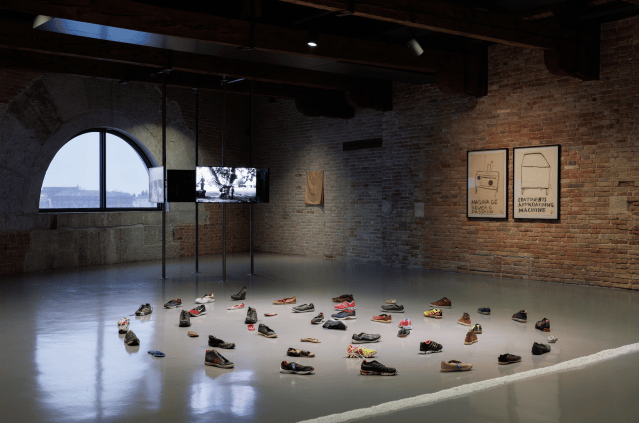
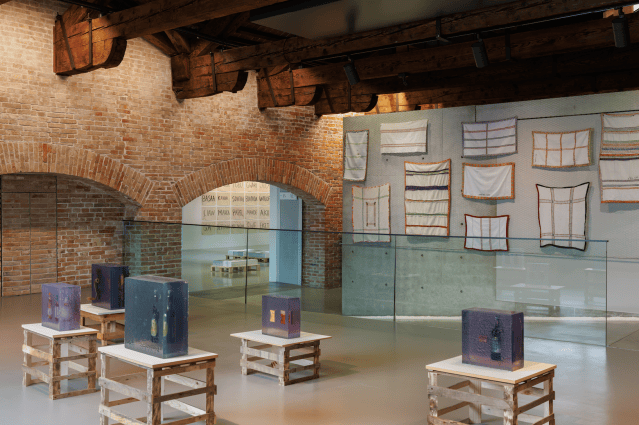
Images: 1- Paulo Nazareth, autoportrait – 2- Paulo Nazareth, Cuando me busqenen el desierto, “Paulo Nazareth. Algebra”, 2026, Punta della Dogana, Venezia. Jacopo Salvi © Palazzo Grassi, Pinault Collection – 3- (floor) Paulo Nazareth, SACI, 2020, courtesy of the artist and Mendes Wood DM, São Paulo, Brussels, Paris, New York. (wall, from left to right) Paulo Nazareth, Oblie, 2016, Pinault Collection; MAQINA DE REVER O PASSADO, 2019, courtesy of the artist and Mendes Wood DM, São Paulo, Brussels, Paris, New York; CONTINENTS APPROACHING MACHINE, 2019, courtesy of the artist and Mendes Wood DM, São Paulo, Brussels, Paris, New York. (center, video) Paulo Nazareth, L’Arbre D’Oublier, 2013, Pinault Collection. Installation view, “Paulo Nazareth. Algebra”, 2026, Punta della Dogana, Venezia. Jacopo Salvi © Palazzo Grassi, Pinault Collection – 3- (floor) Paulo Nazareth, SACI, 2020, courtesy of the artist and Mendes Wood DM, São Paulo, Brussels, Paris, New York. (wall, from left to right) Paulo Nazareth, Oblie, 2016, Pinault Collection; MAQINA DE REVER O PASSADO, 2019, courtesy of the artist and Mendes Wood DM, São Paulo, Brussels, Paris, New York; CONTINENTS APPROACHING MACHINE, 2019, courtesy of the artist and Mendes Wood DM, São Paulo, Brussels, Paris, New York. (center, video) Paulo Nazareth, L’Arbre D’Oublier, 2013, Pinault Collection. Installation view, “Paulo Nazareth. Algebra”, 2026, Punta della Dogana, Venezia. Jacopo Salvi © Palazzo Grassi, Pinault Collection