MICHELANGELO PISTOLETTO, ‘LA SOGLIA’, GALLERIA CONTINUA SAN GIMIGNANO
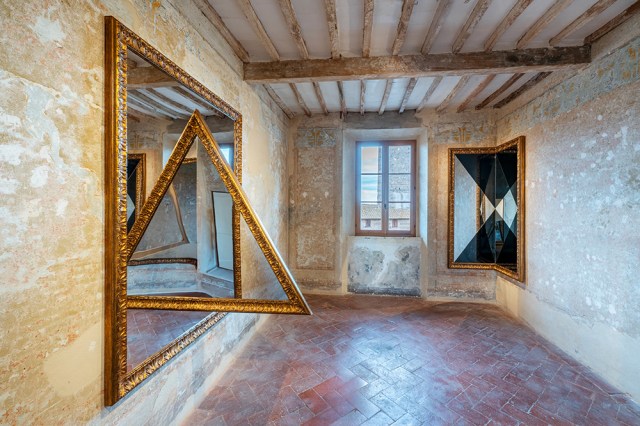
MICHELANGELO PISTOLETTO – LA SOGLIA – Galleria Continua San Gimignano – Jusqu’au 07.01.2026
La Galleria Continua présente l’exposition personnelle de Michelangelo Pistoletto, « La Soglia ». Depuis plus de soixante ans, Pistoletto repousse les frontières entre l’art et la vie, invitant le spectateur à pénétrer dans ses surfaces réfléchissantes et à s’immerger dans l’œuvre elle-même. Fidèle à l’élément signature de l’artiste, le miroir, l’exposition présente une série d’œuvres nouvelles et récentes qui témoignent d’une recherche continue et évolutive.
Dans ce dernier corpus, Pistoletto explore l’interaction entre le réel et le virtuel, entre l’espace bidimensionnel et tridimensionnel, et le rôle du spectateur. Dans ces œuvres, un objet réel est placé devant un miroir, dont l’apparence change selon la perspective de l’observateur. La surface réfléchissante non seulement complète et prolonge visuellement l’objet, mais invite également à une contemplation plus profonde, favorisant une prise de conscience de soi et de sa relation avec son environnement.
Divisione e moltiplicazione dello specchio (2025) fait partie de la série de Pistoletto, Divisione e moltiplicazione dello specchio – L’arte assume la religione, présentée pour la première fois en 1978 avec une œuvre du même nom accompagnée d’un texte de référence. Le concept part de l’idée qu’un miroir peut tout refléter sauf lui-même. Pourtant, en coupant le miroir en deux et en faisant glisser une moitié le long de l’axe de division vers l’autre, le miroir commence à se refléter et à se multiplier, créant une perspective qui s’étend à l’infini. Ce phénomène sous-tend une grande partie de l’œuvre et de la pensée de Pistoletto, le principe de division servant de fondement universel à la croissance organique et, sur le plan social, de logique alternative à l’accumulation et à l’exclusion. Dans les œuvres présentées dans cette exposition, les miroirs divisés sont disposés dans les angles de la salle, intentionnellement décalés les uns par rapport aux autres pour la première fois.
Dans l’installation Uno specchio rotto (2025) de San Gimignano, des fragments de miroirs encadrés sont disposés au mur, se chevauchant partiellement, rappelant visuellement l’œuvre de 1981, Il disegno dello specchio, qui présentait également des miroirs encadrés, certains entiers, d’autres divisés. Alors que les miroirs divisés de l’œuvre précédente présentaient des bords nets, découpés selon un dessin précis, les formes et les bords irréguliers des miroirs de la nouvelle œuvre – et le titre lui-même – évoquent un acte de rupture et d’écrasement. Ce contraste souligne la distance temporelle entre les deux œuvres et met en lumière l’évolution de la pratique de Pistoletto au sein de la longue recherche initiée en 1978 avec Divisione e moltiplicazione dello specchio – L’arte assume la religione.
Michelangelo Pistoletto est né en 1933 à Biella, où il vit et travaille. En 1962, il crée les Quadri Specchianti, qui lui valent une reconnaissance internationale. Acteur de la scène Pop Art new-yorkaise et pionnier de l’Arte Povera, il réalise la série sculpturale Oggetti in meno (1965-1966) et débute sa série évolutive Venere degli stracci en 1967, toutes deux utilisant des matériaux du quotidien. La même année, il commence à organiser des happenings et des performances hors des espaces d’exposition traditionnels et, en 1968, il fonde la compagnie de théâtre interdisciplinaire Lo Zoo.
Dans les années 1990, il fonde Cittadellarte – Fondazione Pistoletto, plaçant le changement social au cœur de sa pratique. En 2023, il dévoile une série de nouvelles œuvres intégrant des codes QR et des technologies d’intelligence artificielle, inventant ainsi le terme de méta-œuvre. Il a reçu de nombreuses distinctions internationales, dont le Lion d’or pour l’ensemble de sa carrière à la Biennale de Venise (2003), le prix Wolf de la Fondation Wolf (2007) et le Praemium Imperiale pour la peinture de la Japan Art Association (2013).
——————————–
Galleria Continua presents Michelangelo Pistoletto’s solo exhibition, La Soglia. For over sixty years, Pistoletto has challenged the boundaries between art and life, inviting viewers to step into his reflective surfaces and become part of the artwork itself. Staying true to the artist’s signature element— the mirror—the exhibition features a series of both new and recent works that highlight an ongoing, evolving investigation.
In this latest body of work, Pistoletto investigates the interplay between the real and the virtual, between two-dimensional and three-dimensional space, and the role of the viewer. In these pieces, a real object is positioned before a mirror, whose appearance shifts with the observer’s perspective. The
reflective surface not only completes and visually extends the object but also invites deeper contemplation, fostering an awareness of oneself and one’s relationship with the surrounding environment.
Divisione e Moltiplicazione dello specchio (2025) is part of Pistoletto’s long-running series Divisione e moltiplicazione dello specchio – L’arte assume la religione, first presented in 1978 with a work of the same name accompanied by a reference text. The concept begins with the idea that a mirror can reflect anything except itself. Yet, by cutting the mirror in two and sliding one half along the axis of division toward the other, the mirror begins to reflect itself andmultiply, creating a perspective that expands
infinitely. This phenomenon underpins much of Pistoletto’s work and thought, with the principle of division serving as a universal foundation for organic growth and, on a social level, as an alternative logic to accumulation and exclusion. In the works on display in this exhibition, the divided mirrors are positioned in the corners of the room, intentionallyoffset from one another for the first time.
In the San Gimignano installation Uno specchio rotto (2025), framed mirror fragments are arranged on the wall, partially overlapping, visually recalling the 1981 work Il disegno dello specchio, which also featured framed mirrors—some whole, some divided. Whereas the divided mirrors in the earlier work had clean
edges, cut according to a precise design, the irregular shapes and edges of the mirrors in
the new work—and the title itself—evoke an act of breaking and crushing. This contrast underscores the temporal distance between the two works and highlights the evolution of Pistoletto’s practice within the long-running line of inquiry that began in 1978 with Divisione e moltiplicazione dello specchio – L’arte assume la religione.
About the artist: Michelangelo Pistoletto was born in 1933 in Biella, where he continues to live and work.
In 1962, he created the Quadri Specchianti, which brought him international recognition. A participant in the New York Pop Art scene and a pioneer of Arte Povera, he produced the sculptural series Oggetti in meno (1965–66) and began his evolving series Venere degli stracci in 1967, both using everyday materials. That same year, he started organizing happenings and performances outside traditional xhibition spaces, and in 1968 he founded the interdisciplinary theater company Lo Zoo.
In the 1990s, he established Cittadellarte – Fondazione Pistoletto, placing social change at the center of his practice. In 2023, he unveiled a series of new works incorporating QR codes and artificial intelligence technologies, coining the term meta-work. He has received numerous international honors, including the Golden Lion for Lifetime Achievement at the Venice Biennale (2003), the Wolf Prize from the Wolf Foundation (2007), and the Praemium Imperiale for painting from the Japan Art Association (2013).
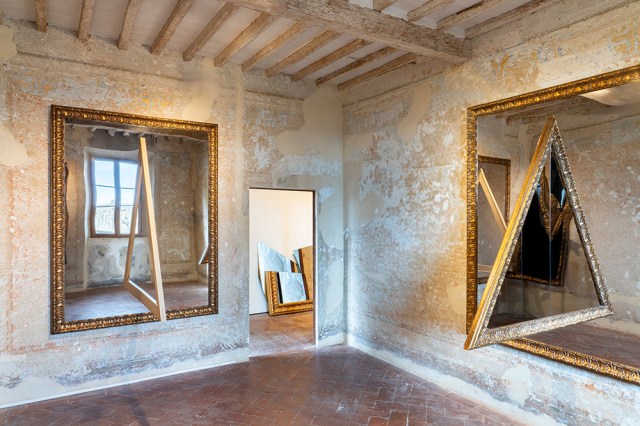
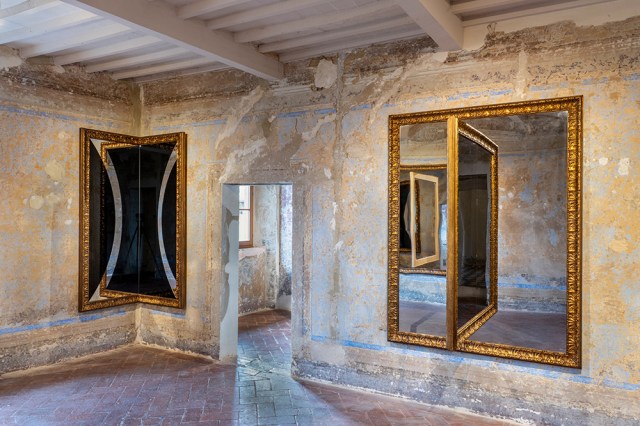
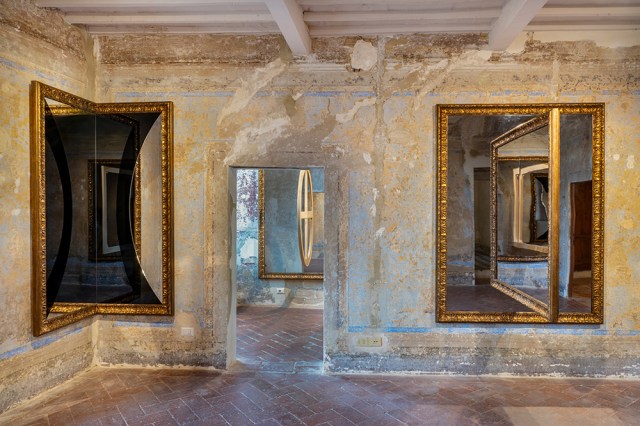
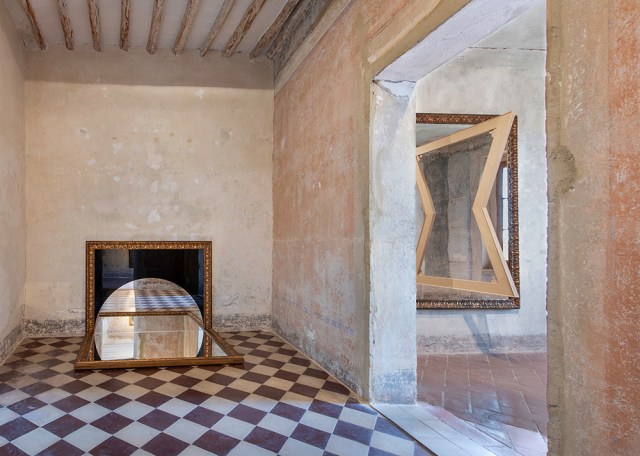
Images: Michelangelo Pistoletto – La Soglia 2025, exhibition view Galleria Continua, San Gimignano. Photo: Ela Bialkowska, OKNO Studio