« IO SONO UN PITTORE », L’AFFIRMATION ICONOCLASTE DE JANIS KOUNELLIS AU MASI DE LUGANO
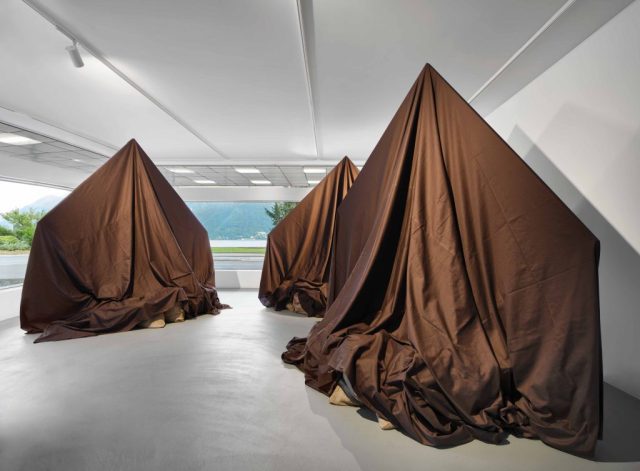
JANIS KOUNELLIS: IO SONO UN PITTORE – Collezione Giancarlo e Danna Olgiati – MASI Museo d’arte della Svizzera italiana, Lugano (CH) – Until 17.01.2027.
Jannis Kounellis : Io sono un pittore , exposition organisée par Vincenzo de Bellis en collaboration avec les Archivio Kounellis de Rome, est la première exposition à examiner l’œuvre de Jannis Kounellis (Le Pirée, 1936–Rome, 2017) à travers le prisme de la peinture.
La Collection Giancarlo et Danna Olgiati à Lugano accueille cette exposition de Jannis Kounellis, figure majeure de l’Arte Povera, proposant une réinterprétation de l’œuvre de l’artiste à travers l’affirmation constante de son identité de peintre, malgré son éloignement progressif du geste pictural traditionnel.
Au cœur de l’exposition se trouve une phrase que l’artiste employait souvent : « Je suis peintre. » Pour Kounellis, cette affirmation relevait moins d’une technique ou d’un médium que de l’expression d’une manière singulière d’appréhender le réel. Couvrant l’ensemble de sa carrière, l’exposition rassemble plus de 35 œuvres réalisées entre la fin des années 1950 et 2014. Plutôt que de suivre un parcours chronologique, elle se déploie comme une constellation de liens : entre matière et poids, langage et signes, mémoire et silence, scènes et icônes.
Dans les années 1980 et 1990, Kounellis décrivait sa démarche artistique ainsi : « Peindre n’a jamais été une question de surface, c’est une posture. Une manière d’appréhender le monde, d’y réagir. » Cette affirmation, en apparence paradoxale, est au cœur de la démarche curatoriale, qui explore comment Kounellis a étendu le concept de peinture au-delà de la toile, en utilisant des matériaux tels que le fer, le charbon, le feu, les sacs de jute et l’arôme du café. Le commissaire d’exposition Vincenzo de Bellis souligne comment l’artiste « peignait avec l’espace, avec le silence, avec le souvenir d’une civilisation méditerranéenne qui se sentait menacée », faisant de cette exposition la première à adopter la peinture comme principal outil d’interprétation de son œuvre.
« Io sono un pittore », reprend ainsi une phrase que Kounellis a souvent répétée tout au long de sa carrière. Cette affirmation trouve son origine dans l’étymologie grecque du mot « peintre », zogràphos , qui signifie « celui qui écrit la vie » ou « celui qui construit des images ». L’exposition est divisée en quatre sections thématiques, conçues pour guider le visiteur selon un parcours circulaire qui privilégie la résonance des thèmes de prédilection de l’artiste plutôt que la progression chronologique.
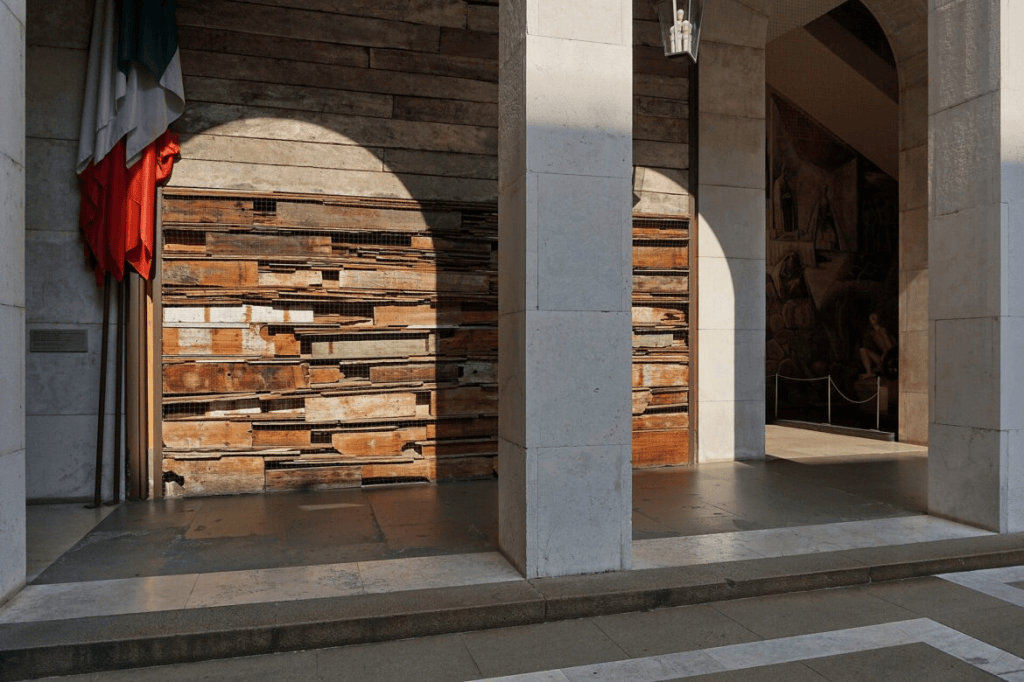
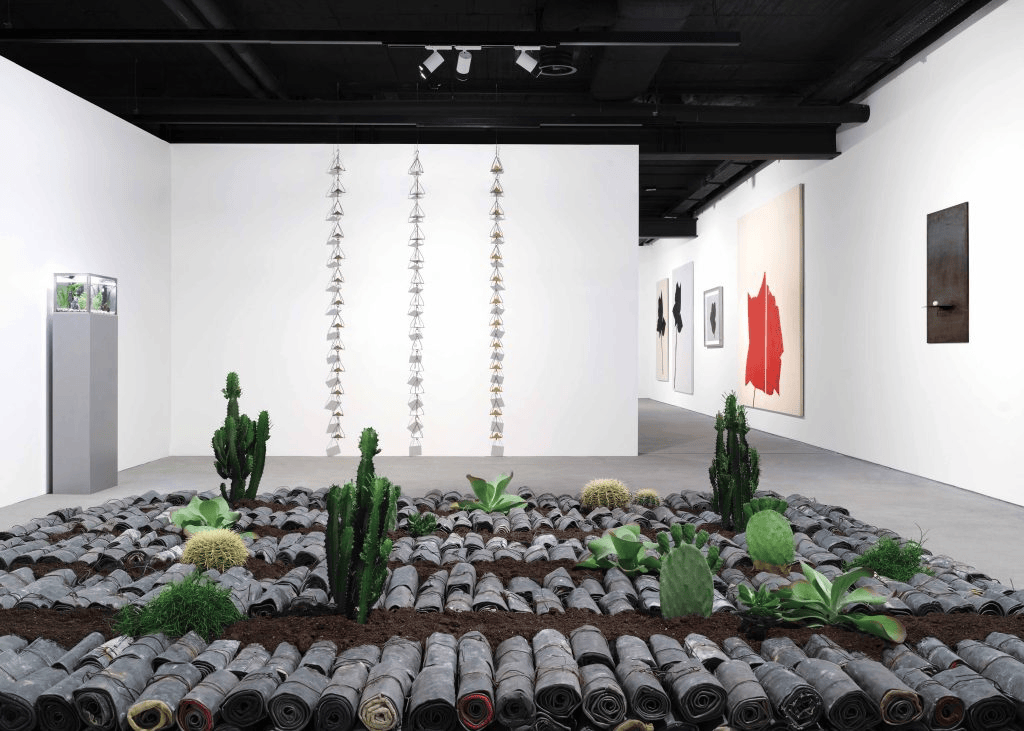
La première section, « La peinture comme langage », présente des œuvres où lettres, chiffres, signes et silhouettes de roses deviennent des éléments à déchiffrer. Parmi celles-ci, « Rose noire sur papier avec fond argenté » (1966) est exposée pour la première fois. La section suivante, « La peinture comme matière et poids », explore le rapport de Kounellis à la matière. Sa vision de peintre y transparaît dans la composition brute d’œuvres qui emploient des éléments tels que des natures mortes, des plantes, du fer, du charbon, de la laine et de la fumée – des matériaux qui, tout au long de l’histoire de l’art, ont généralement été représentés plutôt qu’utilisés directement comme médium pictural. On peut citer en exemple « Sans titre » (1998), réalisé à partir de sacs de jute, de terre, de fer et de tissu.
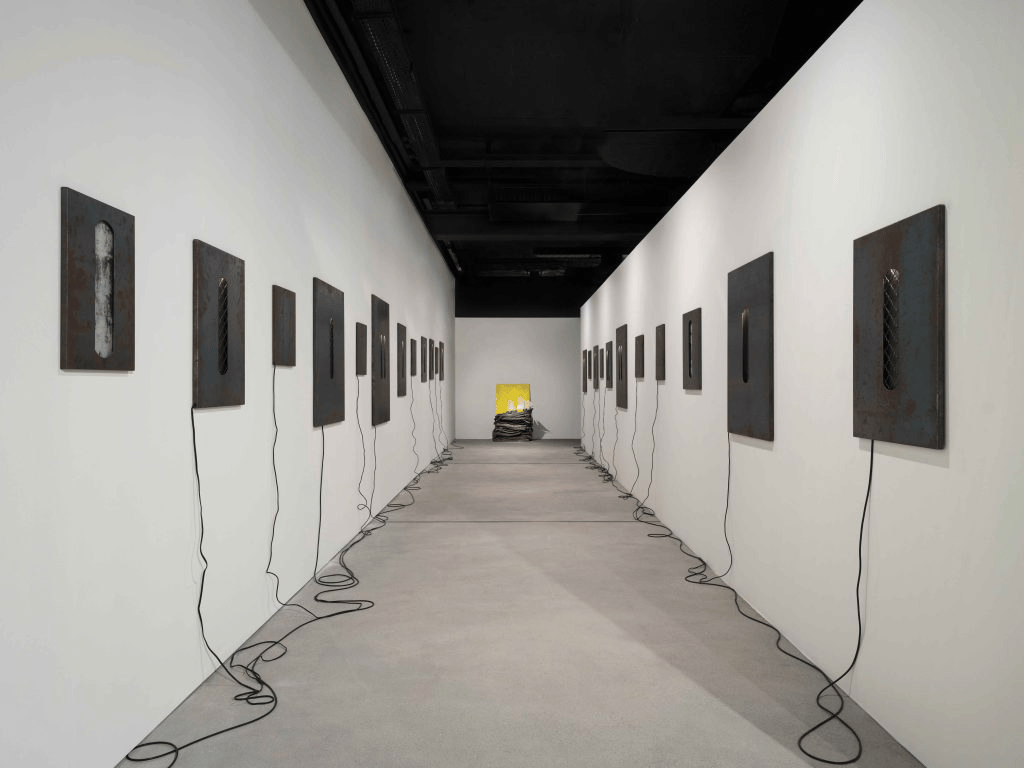
La troisième section, « La peinture comme mémoire et silence », explore les relations de Kounellis avec d’autres figures artistiques. Débutant avec le Carré noir de Malevitch, un couloir de douze mètres se déploie, abritant « Sans titre (Hommage à Van Gogh) ». Cette œuvre, l’un des symboles les plus forts de l’exposition, relie les deux artistes par une quête commune de lumière. Kounellis l’exprime à travers une série de toiles en tôle dont les dimensions font écho à celles des tableaux de Van Gogh, culminant avec une toile jaune qui renforce le lien entre les deux.
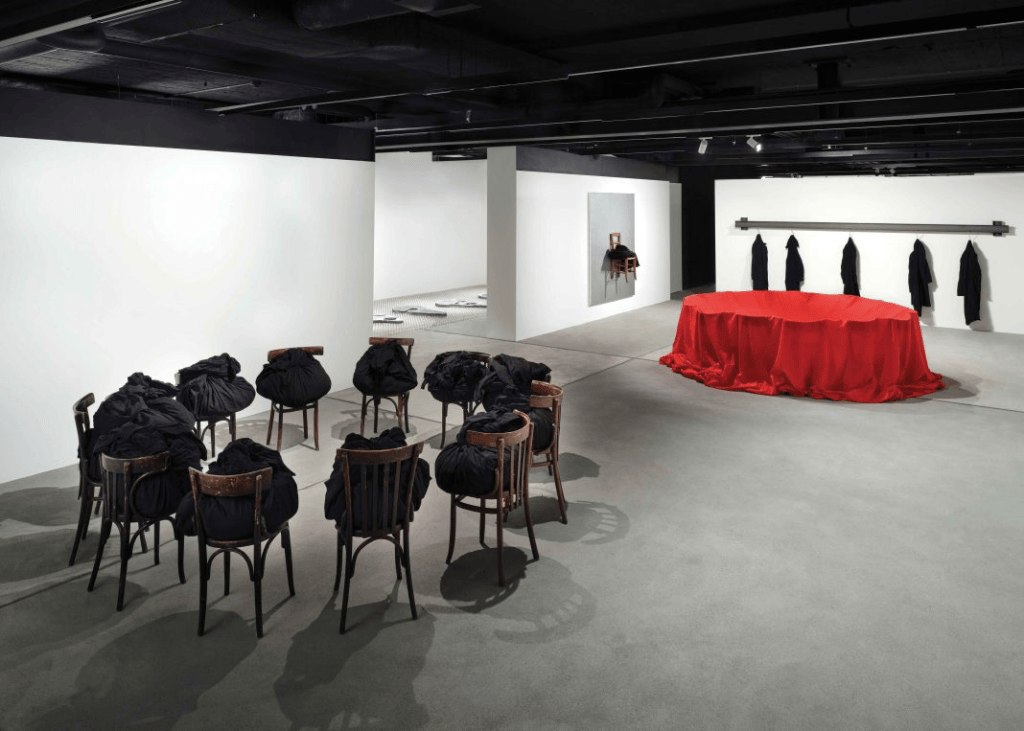
La dernière section, « La peinture comme scène et icône », représente le point culminant émotionnel de l’exposition. Ici, la présence et l’absence de l’artiste coexistent : des dizaines de manteaux suspendus à des poutres, des chaises disposées en cercle, un chapeau et des chaussures accrochés au mur évoquent une présence fugace de Kounellis. Son art, selon le commissaire d’exposition, continue de résonner, interpellant le regard contemporain et engendrant de nouvelles significations.
« Io sono un pittore » fut la dernière exposition à laquelle Giancarlo Olgiati, cofondateur de la collection avec Danna et initiateur de l’événement, put contribuer et dont il put assister à l’achèvement. L’exposition invite le public à renouer avec son être profond, suggérant que l’art peut révéler notre nature intrinsèque de « peintres », même lorsque cela n’est pas apparent de l’extérieur. Cette approche propose une lecture alternative de la pratique de Kounellis : plus large et plus radicale que la conception conventionnelle qui le perçoit principalement comme l’une des figures de proue de l’Arte Povera.
(Par communiqué)
______________
JANIS KOUNELLIS: I AM A PAINTER – Giancarlo and Danna Olgiati Collection – MASI Museo d’arte della Svizzera italiana, Lugano (CH) – Until 17.01.2027.
Jannis Kounellis: Io sono un pittore , an exhibition organized by Vincenzo de Bellis in collaboration with the Archivio Kounellis in Rome, is the first exhibition to examine the work of Jannis Kounellis (Piraeus, 1936–Rome, 2017) through the prism of painting.
The Giancarlo and Danna Olgiati Collection in Lugano is hosting this exhibition of Jannis Kounellis, a major figure of Arte Povera, offering a reinterpretation of the artist’s work through the constant affirmation of his identity as a painter, despite his progressive distancing from the traditional pictorial gesture.
At the heart of the exhibition lies a phrase the artist often used: “I am a painter.” For Kounellis, this statement was less about a technique or a medium than about expressing a unique way of understanding reality. Spanning his entire career, the exhibition brings together more than 35 works created between the late 1950s and 2014. Rather than following a chronological path, it unfolds as a constellation of connections: between matter and weight, language and signs, memory and silence, scenes and icons.
In the 1980s and 1990s, Kounellis described his artistic approach as follows: “Painting has never been about surface; it’s a stance. A way of understanding the world, of reacting to it.” This seemingly paradoxical statement lies at the heart of the curatorial approach, which explores how Kounellis extended the concept of painting beyond the canvas, using materials such as iron, coal, fire, burlap sacks, and the aroma of coffee. Curator Vincenzo de Bellis emphasizes how the artist “painted with space, with silence, with the memory of a Mediterranean civilization that felt threatened,” making this the first exhibition to adopt painting as the primary tool for interpreting his work.
“Io sono un pittore,” echoes a phrase Kounellis often repeated throughout his career. This statement originates from the Greek etymology of the word “painter,” zografhos , which means “one who writes life” or “one who constructs images.” The exhibition is divided into four thematic sections, designed to guide visitors along a circular path that emphasizes the resonance of the artist’s recurring themes rather than chronological progression.
The first section, “Painting as Language,” presents works in which letters, numbers, symbols, and rose silhouettes become elements to be deciphered. Among these, “Black Rose on Paper with Silver Background” (1966) is being exhibited for the first time. The following section, “Painting as Matter and Weight,” explores Kounellis’s relationship to matter. His vision as a painter is evident in the raw composition of works that employ elements such as still lifes, plants, iron, coal, wool, and smoke—materials that, throughout art history, have generally been represented rather than used directly as a pictorial medium. One example is “Untitled” (1998), made from burlap sacks, earth, iron, and fabric.
The third section, “Painting as Memory and Silence,” explores Kounellis’s relationships with other artistic figures. Beginning with Malevich’s Black Square, a twelve-meter corridor unfolds, housing “Untitled (Homage to Van Gogh).” This work, one of the exhibition’s most powerful symbols, connects the two artists through a shared quest for light. Kounellis expresses this through a series of sheet-metal canvases whose dimensions echo those of Van Gogh’s paintings, culminating in a yellow canvas that reinforces the link between the two.
The final section, “Painting as Scene and Icon,” represents the emotional climax of the exhibition. Here, the artist’s presence and absence coexist: dozens of coats hanging from beams, chairs arranged in a circle, a hat and shoes pinned to the wall evoke Kounellis’s fleeting presence. His art, according to the curator, continues to resonate, challenging the contemporary gaze and generating new meanings.
“Io sono un pittore” was the last exhibition to which Giancarlo Olgiati, co-founder of the collection with Danna and initiator of the event, was able to contribute and whose completion he witnessed. The exhibition invites the public to reconnect with their inner selves, suggesting that art can reveal our intrinsic nature as “painters,” even when this is not outwardly apparent. This approach offers an alternative reading of Kounellis’s practice: broader and more radical than the conventional conception that primarily sees him as one of the leading figures of Arte Povera.
(By press release)
______________
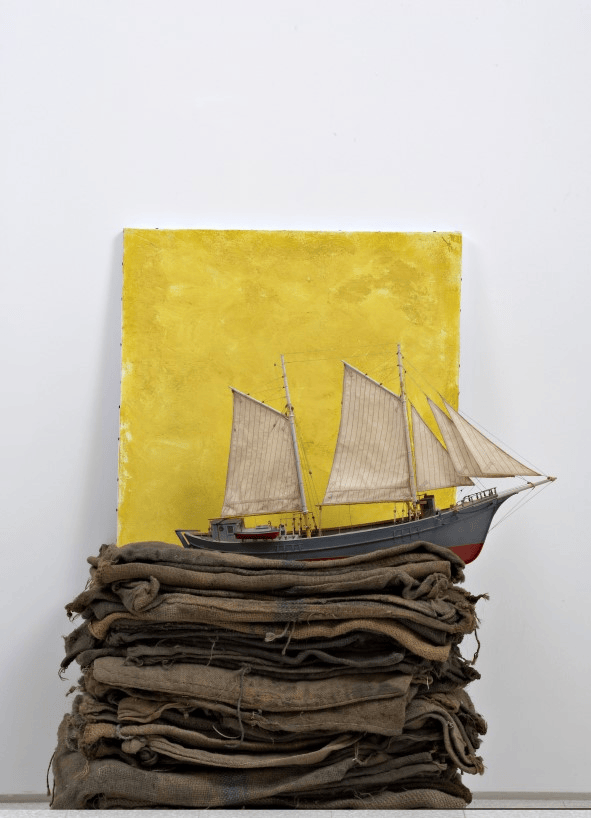
Images: 1- Jannis Kounellis, Senza titolo, 1978. Sacchi di juta, modello di barca, pigmento su tela 132 x 78 x 59 cm. Collezione Maramotti, Reggio Emilia © Estate of Jannis Kounellis / 2026, ProLitteris, Zurich. Photo: Carlo Vannini – 2- Senza titolo, 1998. Sacchi di juta, terra, ferro, tessuto, Dimensioni variabili. Collezione privata © Estate of Jannis Kounellis / 2026, ProLitteris, Zurich Photo © Agostino Osio – 3, 4, 5, 6- Exhibition views: Io sono un pittore – Collezione Giancarlo e Danna Olgiati, Lugano, Photo © Agostino Osio – Copyright Estate of Jannis Kounellis / 2026, ProLitteris, Zurich – Courtesy MASI, Lugano,